

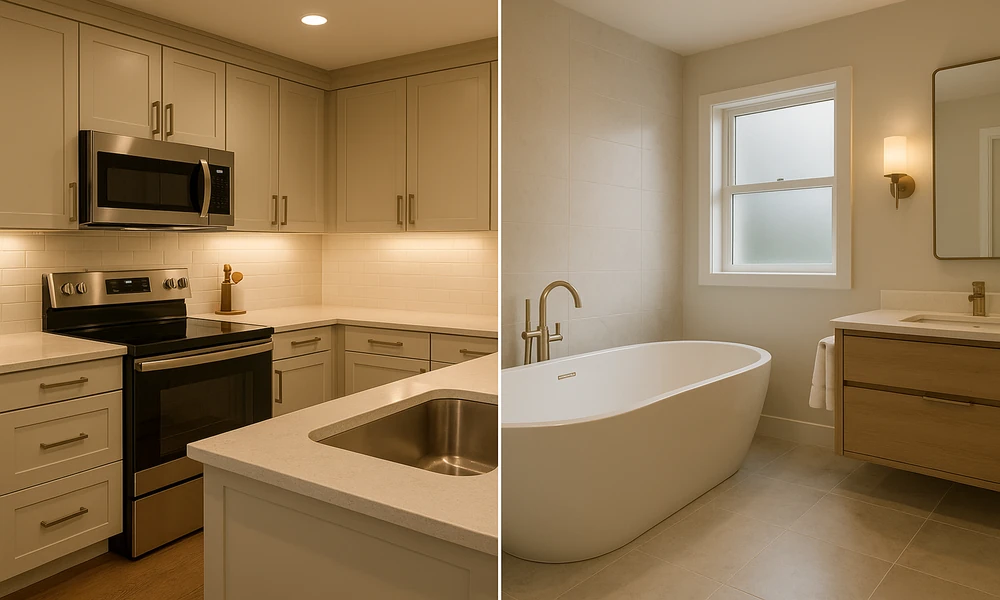
Most homeowners get this wrong. They assume bigger means better, so they gut the kitchen for $80,000 and expect a windfall at closing. The reality is messier, and the decision between a kitchen remodel and a bathroom remodel isn’t about which room you personally like more. It’s about timing, scope, and what buyers in your specific market actually care about.
Spend the next five minutes with this, and you’ll have a clear picture of which project makes more financial sense for your situation before you write a single check.
Why These Two Rooms Drive Almost Every Buyer Decision
Walk into any open house and watch where people linger. It’s always the kitchen and the bathrooms. Buyers don’t just inspect those spaces; they imagine themselves in them. A cracked tile in a bathroom or a cramped, dark kitchen layout triggers a mental discount before anyone even makes an offer.
That emotional weight is why both rooms consistently top every survey of projects worth doing before listing. But emotional weight and financial return are not the same thing, and confusing the two is exactly how homeowners end up over-investing in spaces that don’t recover their cost at sale.
The key question isn’t “which room should I update?” It’s “how much of my investment will I see again at closing?”
What the Spending Data Actually Shows
The home remodeling market has been running hot for years. Home improvement and repair spending vaulted from $404 billion in 2019 to $611 billion in 2022, and is expected to remain above $600 billion through 2025, according to the Harvard Joint Center for Housing Studies’ Improving America’s Housing 2025 report. That’s not a pandemic blip. That’s sustained demand driven by aging housing stock and rising home values.
What that spending data doesn’t tell you is whether any particular homeowner got their money back. For that, you need project-level return figures, and those figures tell a very different story depending on whether you’re talking about a minor kitchen refresh or a full gut renovation.
A minor kitchen remodel, the kind where you reface cabinets, swap out countertops, and replace the appliances without moving walls, consistently outperforms a major overhaul on resale ROI. A major kitchen renovation, by contrast, often returns only about half its cost at sale. The math flips hard depending on scope. The same pattern holds in bathrooms: a clean, well-executed midrange update beats an over-the-top luxury remodel in terms of dollars recovered.
The Scope-First Decision Matrix
Before you pick a room, run your situation through what I call the Scope-First Decision Matrix. It’s four variables that should shape your choice, in this order:
- Timeline to sale. Selling within 12 months? Prioritize resale ROI above all else. Staying five or more years? Lifestyle value matters just as much as financial return.
- Current condition. If your kitchen is dated but functional and your bathroom has visible water damage, grout failure, or mold risk, the bathroom wins by default. A buyer’s inspector will flag it. A buyer’s agent will negotiate against it.
- Neighborhood comparables. Pull three recently sold homes near yours. What did their kitchens and bathrooms look like in the listing photos? If every comp has quartz countertops and subway tile, your avocado green appliances are costing you money every day they sit there. Match the neighborhood, don’t exceed it.
- Budget ceiling. Below $25,000, a bathroom update almost always delivers a tighter, more predictable return than a kitchen project at the same price. Above $50,000, a kitchen can make sense if your comp analysis supports it.
Run those four in order and most homeowners find their answer before they ever need a contractor’s opinion.
A Real Scenario: Marcus in Pasadena Makes the Call
Consider a homeowner like Marcus, who bought a 1988 colonial in Pasadena, Maryland, eight years ago. He’s planning to list in about 14 months. His kitchen has original oak cabinets, a working dishwasher, and laminate countertops that look tired but aren’t broken. His hall bathroom, shared by two kids, has a cracked shower surround and a vanity that’s actively pulling away from the wall.
Running the Scope-First Decision Matrix: his timeline is short, his bathroom has a condition problem that will show up in inspection, his neighborhood comps all have updated baths but only about half have renovated kitchens, and his budget is $30,000.
The answer is obvious once you lay it out: fix the bathroom first, all the way. A new shower surround, a floating vanity, fresh tile, and updated fixtures for around $18,000 to $22,000 leaves him money to paint the kitchen cabinets and replace the countertops without a full remodel. He matches his neighborhood without blowing past it. That’s the play.
The mistake Marcus almost made? Spending $35,000 on a dream kitchen while leaving a structurally compromised bathroom for the next owner to deal with. Buyers would have spotted it and discounted accordingly.
What Experienced Contractors Actually Recommend
Seasoned remodelers will tell you the same thing the data shows: scope control is more important than room selection. A bloated budget on either project will eat your ROI. The National Association of Realtors’ 2025 Remodeling Impact Report found that homeowners spent about $603 billion on remodels in 2024, and 89% of consumers said housing affordability did not influence their decision to take on a renovation project, per NAR’s remodeling research hub. People are spending confidently, but not always strategically.
The contractors worth trusting push back when clients want to go bigger than the neighborhood supports. A firm like Blue Horizon Renovations, which handles everything from kitchen and bathroom remodels to full home additions in Anne Arundel County, is the kind of operation that will tell you honestly whether your budget aligns with your goals rather than just taking the job.
That honesty is worth paying for. A contractor who talks you out of a $60,000 kitchen when a $22,000 bathroom and $8,000 kitchen refresh would have served you better has just saved you real money.
Your Pre-Commitment Checklist
Before you sign anything with a contractor, work through these five questions:
- Is there a condition problem (water damage, structural failure, mold) in either room? Fix that first, no debate.
- What do the three nearest sold comps look like in their listing photos for both rooms?
- What is your hard out-of-pocket ceiling, and are you comfortable if the project runs 10% to 15% over?
- Are you doing this for resale within 18 months, or for daily use over the next five-plus years?
- Have you gotten at least two detailed written quotes that break out labor, materials, and timeline separately?
If you can answer all five clearly, you’re ready to have a real conversation with a contractor. If you’re still fuzzy on the comp analysis or the budget ceiling, stop, do that work first, and then make the call.
So Which One Wins?
Neither room wins unconditionally. A minor, well-scoped kitchen remodel can outperform a bathroom update on resale ROI in the right market. A targeted bathroom fix will outperform a bloated kitchen renovation almost everywhere. The room matters less than the scope, the timing, and the honest read on what your specific neighborhood demands.
Start with condition, check your comps, set a real budget, and pick the project that closes the biggest gap between your home and the ones buyers are choosing instead. That’s the decision that pays off.
