

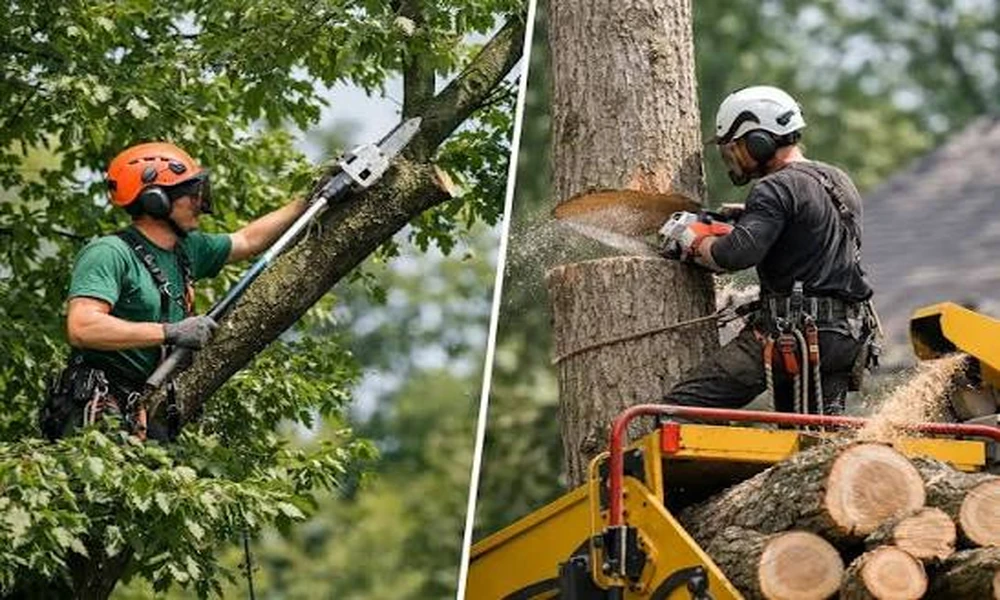
There is a specific kind of tree that appears at the edge of almost every old Singapore landed property: a mature angsana, fig, or rain tree that was planted when the house was built, has spent thirty years growing into its surroundings, and now presents roots under the driveway, branches over the neighbour’s roof, and a trunk diameter that no general contractor is equipped to handle. Tree cutting experts exist for exactly this situation. The combination of arboricultural knowledge, climbing skill, and site management experience they bring is not interchangeable with a crew that happens to own a chainsaw.
Singapore’s managed urban landscape means that even trees within private properties are not entirely private matters. The National Parks Board maintains oversight of significant trees under the Parks and Trees Act, and the fine for unauthorised removal of a protected tree sits at fifty thousand dollars. Getting the work done properly begins with understanding the regulatory status of the tree, not with renting a chainsaw and hoping for the best.
What Distinguishes an Expert from a Generalist
A qualified tree removal expert brings several capabilities that generalist contractors do not. They can assess the structural condition of a tree, identifying whether internal decay, root damage, or past storm damage has made it a hazard. They understand Singapore’s permit requirements and know which applications are likely to succeed. They carry the climbing equipment, rigging systems, and ground support to dismantle a tree safely in a constrained environment.
The structural assessment matters beyond the immediate removal job. A tree that appears healthy from the outside may have significant internal decay that affects how it will behave when cuts are made during removal. An expert arborist identifies this during the site assessment and plans the removal accordingly.
Site Clearance for Development and Renovation
Tree removal for site clearance ahead of construction or major renovation is a distinct service from single-tree removal. Site clearance typically involves multiple trees of varying sizes, root systems that may be intertwined, and a timeline driven by a construction programme rather than the convenience of the tree crew.
For site clearance work, tree cutting companies need to work efficiently with heavy equipment such as excavators and wood chippers while maintaining safety controls across a larger working area. The regulatory dimension is also more complex: site clearance for development often requires approval from the Urban Redevelopment Authority or other agencies in addition to NParks permits for any protected trees within the site boundary.
Companies experienced in both single-tree removal and site clearance understand how to coordinate these approvals and sequence the work to meet the construction programme without exposing the developer to regulatory risk.
Emergency Tree Removal
Storm events in Singapore regularly bring down trees or leave large branches precariously placed over structures. Emergency tree removal differs from planned removal in several ways. Time pressure is higher. The tree is likely already damaged and therefore less predictable in its behaviour when cuts are made. Access to the site may be impeded by the fallen material itself.
Qualified tree removal experts handle emergency callouts with the same safety controls as planned work, adapted for the specific conditions of the incident. Priority is given to making the immediate area safe, then to systematic removal of material in a controlled sequence.
For insurance purposes, post-storm tree removal that is carried out by a qualified company with documentation of the work completed is considerably easier to claim against a property insurance policy than informal removal with no record of how the work was done.
Stump Removal and Site Restoration
Tree removal is not complete when the trunk hits the ground. The stump that remains is a tripping hazard, a source of ongoing growth from persistent root systems, and, in some cases, a host for fungal infection that can spread to healthy trees nearby.
Stump grinding reduces the stump below ground level, typically to three hundred millimetres below the surface. This depth allows paving or turf to be reinstated over the site. For areas that will be planted, deeper grinding may be advisable to remove more of the organic material that will otherwise decay and cause surface subsidence.
Root barriers, installed around the grinding area, prevent regrowth from peripheral root sections that cannot be economically excavated. These are particularly useful where the stump was adjacent to paving or structures.
For property owners and project managers in Singapore who need trees removed safely, legally, and with a site left in a condition that supports the next phase of their plans, experienced tree cutting experts are the right people for the job, every time.
